

The Geodesic digital library has received the CNRS 2026 Collective Crystal Award.
Geodesic, developed by Mathdoc, is an open-access digital library dedicated to the global mathematical community. Launched in 2025, it now offers more than 472,000 mathematical documents, collected from 42 different sources.
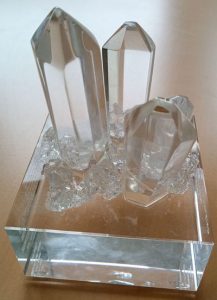
The CNRS’s ‘Cristal Collectif’ award recognises teams of engineers and technicians who have carried out projects characterised by particularly outstanding technical expertise, a collaborative approach, practical applications, innovation and impact.
This Cristal collectif award thus recognises the excellence of the work carried out by the Geodesic team, which is committed to the international open-access dissemination of mathematical research findings and is fully aligned with the open science approach promoted by the CNRS.
The Geodesic team
The 2026 Cristal Collectif award for Geodesic has been attributed to:
- Philippe Besnier (Mathdoc)
- Sacha Besombes (Mathdoc)
- Thierry Bouche(Institut Fourier)
- Taban Danei (Mathdoc)
- Olivier Labbe (Mathdoc)
- Franck Lontin (Mathdoc)
- Céline Smith (Mathdoc)
- Céline Talbi (Mathdoc)
- Grégory Thureau (IRMA, RNBM)
- Olaf Teschke (FIZ Karlsruhe)
- Nathan Tien You (Mathdoc)
Geodesic
Initially funded by the National Fund for Open Science, and with specific support from CNRS Mathématiques, Geodesic was launched in 2025.
Geodesic is a digital library intended for the international mathematical community. Its aim is to provide researchers with the shortest route to open-access articles. Geodesic compiles complete collections of journals, which users can browse, thereby offering a single point of access to a vast corpus of documents: journal articles, conference and seminar proceedings, theses and books.
Geodesic’s sources are rigorously selected with the support of the Réseau National des Bibliothèques de Mathématiques (RNBM) to ensure the reliability and quality of the resources provided. The Geodesic team also enhances the metadata for the documents by drawing on reference databases, in particular the zbMATH Open bibliographic database, operated by FIZ Karlsruhe. Interoperability and free circulation of mathematical research results are thus at the heart of the project.
Geodesic is now continuing to expand its collections by regularly incorporating new sources of documents.